What this is
This guide is a 14-day routine for anyone at home who wants to try the principle behind the Amornphat Method: don't teach the goal, show enough real examples, and let the child choose.
This guide has two parallel tracks. The main track below is written for use at home, with one or two children. A second track, "In the Classroom", is on the "At School" page and is written for a teacher with thirty children at once. Same core method, different way of asking the question.
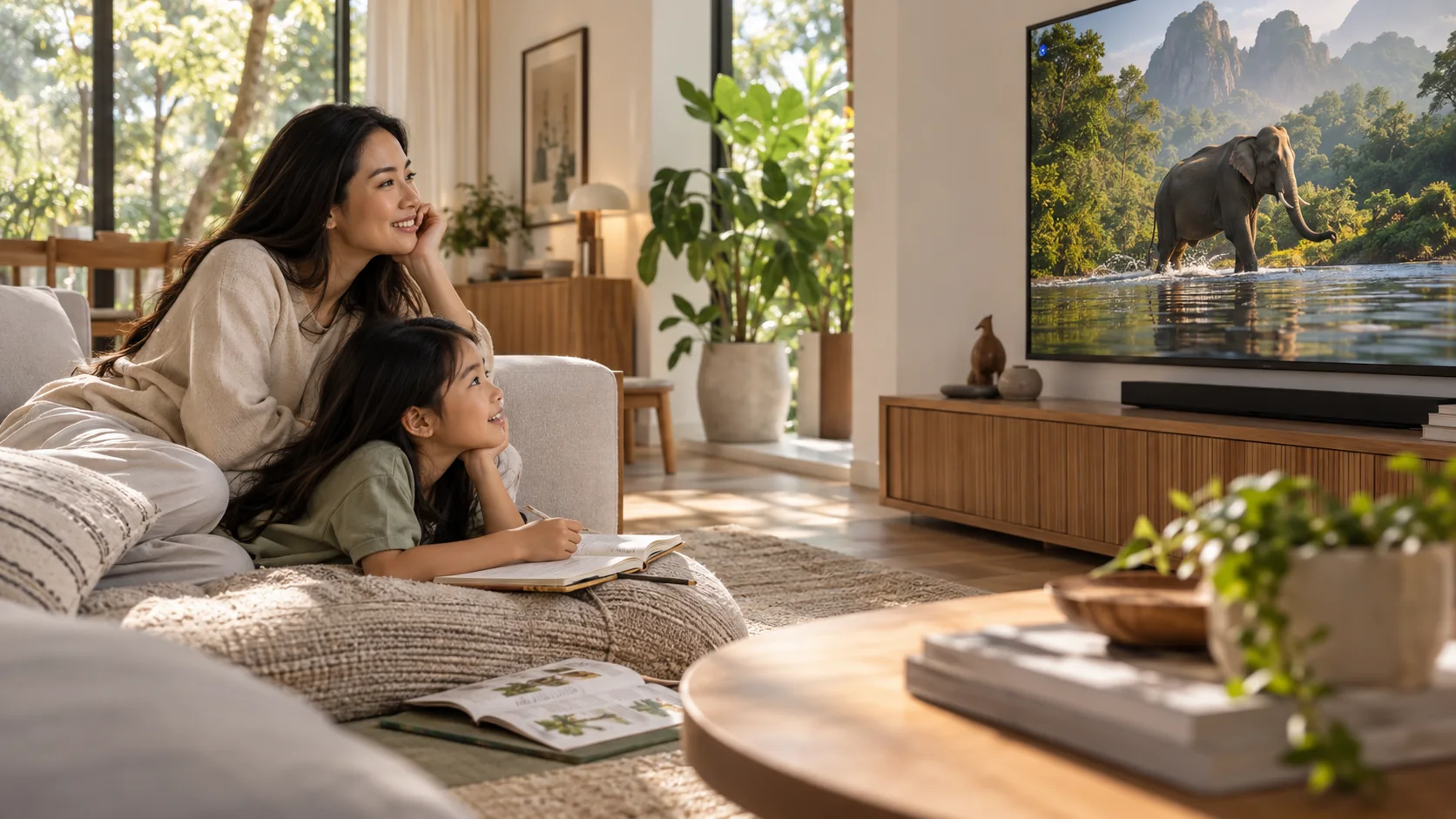
Use documentaries in place of the screen time your child already has. You don't need to add any. For more on screen time, see the FAQ.
This works without Doxzilla Learning. That's the main path here, not a fallback, and it's what makes the word "free" in this method actually true.
Choosing documentaries for a child: four checks
This method asks a child to watch one documentary a day, every day, from age 3 to 18. What the child watches matters as much as the watching.
Find documentaries anywhere. Make sure each one has all four of these.
Curated Content
Someone chose this documentary for children, and can tell you why. A child who walks past one barbershop every day knows one job. Documentaries chosen on purpose, from many kinds of work and many parts of the world, make that picture bigger.
Ask: who picked this one, and why?
Age Classification
The documentary says which ages can watch it and what to know first, such as which films suit young children and which suit older ones. A label helps you choose faster, and it helps most when you have no time to watch first. But if the child is under 9, please skim the whole documentary first.
Ask: was this label made for this documentary, and did the person who made it actually watch it?
Fact Check
Someone has checked that what the documentary says is true, and says plainly what could not be checked. A child builds a picture of what's possible from what they see. If what they see isn't true, the picture isn't either.
Ask: who checked it, and is it someone other than the people who made it?
Trust
You can tell who stands behind it, who pays for it, and who to tell if something is wrong. This method asks you to step back day after day, for years, and that only works with a source you can rely on.
Ask: can I find a name I can contact, and what happens if something is wrong?
If all four are there, press play. If one isn't, try another.
A convenience option, not a required step. If you can't find documentaries that meet all four, we've prepared them at Doxzilla Learning (doxzilla.com/learning), which is built around these four standards. Sign-up details are on that page. The method itself works anywhere, with or without it. Doxzilla Learning is a different site from amornphat.com, which is where the method itself lives.
This section is general information, not part of a commercial offer.
Before You Start — 30 Seconds
| Age | Suggested time per day |
|---|---|
| 3–5 | 15 minutes |
| 6–8 | 25 minutes |
| 9–11 | 30 minutes |
| 12–14 | 40 minutes |
| 15–17 | 55 minutes |
The times in the table are suggestions, not targets you have to reach.
Some days a child will watch less because they are tired, can't concentrate, or the film just doesn't appeal. That's fine. Stop, and watch again tomorrow. A shorter time every day still helps, because what helps a child is watching consistently, day after day.
If an older child loves a film and wants to see it through to the end, going over the time in the table is fine.
For kindergarten children, we suggest staying within the time in the table.
If a child watches the suggested time every day, from kindergarten to the end of secondary school, that adds up to about 3,000 hours.
Note: This content is provided for general informational purposes only and does not constitute medical advice. It is not a substitute for guidance from a qualified paediatrician or child development professional. If you have concerns about your child's development or behaviour, please consult a doctor directly. Screen-time guidance on this page references the general public guidance from AAP and WHO for children aged 2-5 (up to 60 minutes/day across all screens combined). The suggested Doxzilla Learning viewing time is intended as part of — not in addition to — that overall daily allowance. References to AAP and WHO on this page refer to their publicly published general guidance and do not imply that AAP or WHO has reviewed, endorsed, or is affiliated with Doxzilla Learning or the Amornphat Method.
One rule covers every day: one documentary a day. Watch it, then ask one question. No more than 2 minutes. It's a short chat, and every answer is fine.
Choosing for young children
For ages 3 to 8, choose films with slow pictures and soft sound. Plenty fit, such as animals looking for food, sleeping or raising young, or people making sweets, farming rice or throwing pots.
Children 3 to 5 should have someone sitting with them. For 6 to 8, sit with them when the film has heavier scenes; if they watch alone, someone should be in the house and able to come at once. Take a break whenever they aren't comfortable. The scenes to leave for later are listed under "Choosing Films for Young Children" at the bottom of the page.
The 14-Day Plan
This plan sets only the category for each day. Choose the documentary within it using the four questions below. Have them ready before day 1. They work the same every day, so ask them before every play.
Before you press play, ask four things
1. Did someone choose this for children? 2. Does it say which ages can watch, and what to know first? 3. Has someone checked that what it says is true? 4. Do you know who stands behind it, and who to tell if something is wrong?
If you can answer yes to all four, press play. If not, try another.
| Day | Category |
|---|---|
| 1 | Animals |
| 2 | Animals |
| 3 | Animals |
| 4 | Working people |
| 5 | Animals |
| 6 | Working people |
| 7 | Science / technology |
| 8 | Working people |
| 9 | Places / how things are made |
| 10 | Working people |
| 11 | Science / technology |
| 12 | Animals |
| 13 | Places / how things are made |
| 14 | Working people |
Across 14 days: animals 5 days · working people 5 days · science/technology 2 days · places/how things are made 2 days.
(This plan sets only the category for each day, not the title. You choose the documentary within the category, and the four questions above tell you whether it's fine to press play.)
Why this order
- Animals first (days 1–3): every age warms to animals fastest, with the least explaining needed. The first three days are for building the habit of watching daily, not yet for content that demands more focus.
- Working people starts on day 4, not day 1: the habit needs to settle before the category that matters most to this method begins.
- Working people appears more than any other category (5 of 14 days): what helps a child start picturing their own future is watching real people at real work, not animals or places. Wildlife documentaries weren't built to do that job.
- Animals return throughout, not all bunched at the start: so the 14 days have variety and don't end up feeling like a single wildlife channel.
- Day 14 closes on working people: it restates this method's central question right before day 15, when the child starts choosing more on their own.
Day 15 — What's Next
14 days is the start, not the goal. This method is designed to run from kindergarten through the end of secondary school (ages 3 to 18). Follow the suggested time every day and that adds up to about 3,000 hours of real life across those years. Whatever the source of the first 14 days (the four checks still apply), from day 15 on, the approach is the same for everyone:
- Keep the same daily rhythm. One documentary a day, one question a day (or no question at all, for older teens).
- Keep roughly the same category mix (animals / working people / science-technology / places-how things are made), but you no longer need a fixed plan. Let the child have more say in choosing the category or the title as they get older.
- Lengthen the daily time as the child grows, following the suggested times in the age table.
- If a child starts asking to rewatch something, or asks for the same category for several days running, that's fine. That's the child choosing for themselves, which is the whole point of this method.
From day 15 there are two ways to go on, and either one keeps the method going.
One way is to use Doxzilla Learning. It gives you a library of documentaries already chosen for children, with labels for the ages that can watch them, so you don't have to find each one yourself. Sign-up details are at doxzilla.com/learning.
The other way is to carry on with the method yourself, at no cost. Go back to finding documentaries yourself, with the same four questions, exactly as you could from day one. This way is open to everyone in every country, and readers anywhere can start here from day one. This guide has never depended on paying for anything, whether that's day 15, day 100, or day 365.
This section is general information, not part of a commercial offer.
What You Might See When It's Working
The method works in five steps, one after another. The early steps tend to show first, and the later ones take a year or more. Below is what you might see, in the order of the five steps.
- Seeing enough examples: the child tells you what they saw today, or asks to watch something again.
- Picturing themselves: they act out what they saw, or draw themselves in the picture.
- Choosing for themselves: they say what they'd like to be or try. Changing their mind tomorrow is normal at this age.
- Wanting it from the inside: they keep playing or trying with no one telling them to, such as growing bean sprouts in a glass or modelling an animal from clay.
- Skills following: they use new words, tell it in more detail, or look things up on their own.
In the first week, it's enough to see the child watch to the end without reminders, or ask "What are we watching today?" The first 14 days build a habit, not a final result. If you don't see a given thing yet, that's fine, because every child gets there at their own pace. A child doesn't need to show all of these, and some show them through drawing or play more than words. These signs don't mean the child has chosen a life goal. Notice quietly, with no need to question or chase the child.
By age and by period, see Your Child's Year.
What to do when you see a good sign
Praise the curiosity. Say "Good question" or "Interested in that? Tell me more." Avoid "Clever you", because it teaches a child to answer just to hear the praise.
Follow the child's interest. Whatever they're curious about, find another film on it, or take them to see the real thing nearby, such as a farm, a market, a temple, a rice field or a workshop down the street. Ask the owner's permission first, and go with someone you trust.
Let an interest stay an interest, not yet a career plan. If a child says they want to be a doctor, listen as you would to any other story. No need to buy things or sign up for courses yet. No need to remind them next week, "I thought you wanted to be a doctor," or to tie it to exams or grades. A child can change their mind tomorrow, and should be able to.
What the People at Home Get
- Time together every day, a few minutes, with no special activity. Ask at dinner, in the car, or while doing chores.
- Learning together. If a child asks something you can't answer, say "I don't know either. Shall we find out together?" and then find out together.
- Parents who work far away get something to talk about on the phone. Asking "What did you watch today?" is enough for the child to have a turn.
- If grandparents live in the home, they get to be the storytellers. They don't need to know anything about documentaries. If they've kept animals, farmed rice, or done the work the child just saw, they can tell the child their own real story, which a school can't give.
The Daily Question — Under 2 Minutes
These rules apply to every question:
- Open, not closed. Every answer is fine. Ask, then listen. Don't ask and then supply the answer yourself.
- Short. Ask once. Don't press. Don't repeat the question if the child doesn't want to answer. If a child wants to pass, just say "Sure" and move on.
- Every answer is fine. No scoring, no notes, no comparing with a sibling or anyone else.
- Listen to every answer with the same face and the same tone. If the child says "I don't know," answer "Mm, thanks for telling me." If you only praise the answers you like, the child starts answering to please you.
- Don't correct a mistake on the spot. Save it for another day: "Shall we look that up together?"
- The child's answers belong to the child. Don't write them down, record them, post them, or retell them to relatives in front of the child.
Base questions by category
These four questions are templates, reused every time that category comes up (the animals category uses the same question on days 1, 2, 3, 5 and 12), not 14 separate questions. Once you remember these four templates, you can carry on after day 14 without the guide at all. (The classroom uses the same four base questions; see the "At School" page.)
| Category | Base question (adjust the wording to the child's age) |
|---|---|
| Animals | "What did that animal do today that amazed you the most?" |
| Working people | "What was hard for the person in today's story, and how did they get through it?" |
| Science / technology | "What in this made you want to know more?" |
| Places / how things are made | "Which step in this amazed you the most?" |
Adjusting for age
- Ages 3–5: ask with the simplest words ("Which one was your favourite?"), then connect it to something the child already knows ("Is that like our cat at home?"). A child this age should have someone sitting with them anyway. This adds no new work.
- Ages 6–8 and 9–11: ask in a way that invites a full sentence ("What's something you'd never seen before?")
- Ages 12–14: shift from "explain" to "debate." Ask for an opinion or a hypothetical ("If you were that person, would you have made the same choice? Why?"). This age doesn't want to be lectured, but will talk if it's a real exchange of views.
- Ages 15–17: don't ask. A teenager can start the conversation when ready. Say it once, on day one only: "Tell me anything you want, whenever you want. You don't have to wait to be asked." Then there is no need to raise it again for the rest of the 14 days. Let your teenager start it if they ever want to, because this method relies on the start coming from the child.
Are you a teacher? The classroom format is on the At School page.
At Home, No Groups Needed
At home there are no groups to form. Talk with whoever is there.
If a parent is at home
Watch together when there's time. You don't need to watch every day. On days you didn't watch together, ask after the child has finished. Ask one question, such as "What was your favourite part?" or "Was there anything that surprised you?" and listen all the way through. Don't add a lesson. Don't sum up the moral. If the child asks you something back and you don't know, say so: "I don't know either. Shall we find out together?"
Children tend to tell you more at the table, in the car, or while doing chores together than when you sit them down for a serious talk, because they don't feel they're being questioned.
Asking in a way that invites a chat works better than asking like an exam: "What was your favourite part?" beats "Do you remember what that animal was called?" Every child has their own pace, so there is no need to compare with a brother or sister.
If both parents work and get home in the evening
Whoever is with the child during the day, whether a relative, a nanny, or anyone else who looks after them, sits and watches with the child. A child under 6 always has someone sitting with them. When the parents get home, they ask the child one question at dinner or during a chat before bed, such as "What surprised you today?" and listen all the way through. They don't need to have seen the same film. On days off, watch together.
If there are brothers and sisters of different ages
Watch the same film. Then let the older child tell the younger one about it. The younger child gets to listen, and the older one gets practice telling without realising it. Choose a film that suits the youngest.
If grandparents help raise the child
Grandparents don't need to know anything about documentaries to talk about them. Ask one question, "What was your favourite part?" and listen all the way through. If a grandparent has seen or done something similar, such as keeping animals or growing rice, they can tell the child about it too. That is something a school can't give.
If the parents work far away
The child saves what they watched to tell on the phone or a video call. A parent only needs to ask, "What did you watch today?" That is enough for the child to have a turn to tell.
On days off
If relatives or a neighbour's child come to play, invite them to watch too. It doesn't have to become an activity.
You don't need to ask every day, write anything down, or test what the child remembers. For other ways to talk, such as on days when time is short, when a parent works far away, or when grandparents are raising the child, see Talk Together.
A Child Who Wants to Speak but Can't
Some children want to speak, but the moment someone looks at them they tighten up, go red, lose their voice or go completely silent. These children need time, and that is perfectly normal. Giving them time and another way to take part helps them feel at ease faster than saying "just try, you'll get used to it."
- From the first day, say that nobody has to speak.
- Offer other ways that count the same, such as drawing, writing one line, pointing at a picture, or giving a thumbs up.
- Never call a child "shy" in front of the child or anyone else.
- When a child who has been silent for a long time starts to speak, praise them gently, as much as you would praise anything else. Don't make it a big moment.
If a child talks at home but has been completely silent at school for a month or more, talk to the child's teacher, and consider seeing a doctor or a child psychologist. There is more detail on the At School page.
If There's No One at Home to Talk To
This still works even if no one at home has time to sit with the child. The most important part of this method is seeing real lives. Being asked about it is an extra.
A child under 6 always has someone sitting with them. If no one at home is free, ask an older brother or sister, a relative, or a trusted neighbour to sit with them, or watch at a nursery or at school.
A child aged 6 to 8 can watch if someone is in the house and can be called straight away, and the films chosen are the gentlest ones, as in the box above.
A child aged 9 or over can watch on their own.
Before a child watches alone, tell them: if you want a break or don't want to keep watching, turn it off. Nobody will be cross. Afterwards, tell anyone you like. If no one is there, save it for the next phone call with a parent or relative far away, or write it in a notebook. For more ways to tell it when no one is there, see Talk Together.
If no one asks anything at all, that's fine. Don't feel guilty.
Choosing Films for Young Children
Films that suit young children
Children aged 3 to 5, and children aged 6 to 8, don't yet fully grasp that what they see on a screen is far away from them. A vivid image can stay in their minds for a long time. What suits them best is slow pictures, soft sound, and clearly visible steps: a baker, a carpenter, a vegetable grower, animals feeding or playing in water.
These scenes can wait until the child is older:
- Animals chasing, biting or eating each other; baby animals being caught; a mother animal dying; a baby animal separated from its mother
- People hurt, blood, surgery, fire, floods, earthquakes
- Sudden loud noises, music that makes you uneasy, people shouting
- Arguments, fighting, war
- Stories about hardship told so as to make us pity them
Jobs with heavy scenes, such as surgeons, firefighters and rescue teams, can wait too.
If they cover their eyes, walk away, cry, keep asking "Is that animal okay?", or say they don't want to watch, it means this film is too heavy today. Stop, and hug them or talk first. Ask gently whether there was a part they didn't like, and choose something gentler tomorrow. Stopping is nobody's fault.
A good time to watch is the afternoon or after the evening meal, at least an hour before bedtime.
If you watch in an app or on a video site, turn off autoplay. Watch one film and switch off, with no need to pick the next one from the recommendations.
A 3-year-old often watches for less time than the table says. Watch as long as the child wants. They don't need to finish.
When a child asks a heavy question after watching
A child who asks about death or about animals hunting is thinking it through, and has chosen someone they trust to ask. That's a good sign.
- Ask back before you answer: "What would you like to know?"
- Keep it short and true. If you don't know, say so, and find out together later.
- Acknowledge the feeling first: "That's sad, isn't it." Then explain.
- About death, say plainly that the body has stopped working: it does not move, it does not hurt, and it does not come back. Don't say "went to sleep," because a young child may become afraid of sleeping.
- If the child sees people who are struggling, talk about how strong they are. There is no need to make the child feel guilty for having it easier.
- End by letting the child know they are safe now, if that's true: "You're here with Mum (or Grandma, or Dad), and you're safe." If no adult is with them at that moment, say "You're at home, the door is locked, and you're safe," if that is true.
At any age
If a child talks about hurting themselves or wanting to die, don't panic, listen all the way through, stay close, don't leave them alone, and take them to a doctor or child psychiatrist as soon as you can, the same day if possible. In Thailand, the Department of Mental Health hotline, 1323, is free and open 24 hours.
If a child can't sleep, has frequent nightmares, or stays unusually quiet for a long time, you can talk to a doctor or the child's teacher. If you're worried, you don't need to wait.
If the child lives with grandparents most of the time, invite them to read this page together, and pick gentle films ahead of time so they can simply press play. If the child asks about their parents after watching, answer truthfully: that their parents are working because they love them and think of them, and when they will come home, if you know. If the child misses them, say that missing them is fine and you are right here.
Ways of asking and watching that work better
- Ask in a way that invites a chat: it works better than asking like a test. Listen to the child's answer all the way through. Every answer is fine, and there is no need to compare with a sibling. This method runs on the child's own curiosity.
- Let the child stay with what they just saw: give them a little while, then talk at dinner or while doing something else. There is no need to sum up a lesson.
- Let the child have a say: the household chooses the category from the plan, and the child helps choose the actual title within it whenever possible. The older the child, the more they choose for themselves. A title the child picks passes the same four questions.
- Notice good signs quietly: keep them to yourself, with no need to question or chase the child.
- Treat watching as the child's own time: there is no need to use it as a reward or a punishment. If the child doesn't want to watch one day, let it go and start again tomorrow.
- Give it a little more time: 14 days is not 14 years. If a child still gives short answers every day, that's normal.
Closing Note
This guide describes a direction you can watch for. Every child goes at their own pace, so it is an invitation to try at home, not a guarantee of any outcome.